Why Write Kanji by Hand? Memory Benefits for N5 Learners
Do you need to write kanji by hand to learn it? See what research says about handwriting and memory, plus a simple 10-minute routine for JLPT N5 beginners.
Why Write Kanji by Hand? Memory Benefits for N5 Learners
You can pass JLPT N5 without ever picking up a pen. The test is multiple choice, and most of us type everything anyway. So is it worth writing kanji by hand?
My answer is yes, for a specific reason: writing makes you look at a character more closely than reading does, and it gives your memory a second route to the same kanji. This post covers what the research does and doesn't show, how handwriting helps with kanji in particular, and a short routine you can start today.
Short Answer
Writing kanji by hand is not required for N5. It is a memory aid, and a good one for beginners.
When you only read a kanji, your brain can get away with a rough impression: "box with a line through it." When you write it, you have to produce every stroke in order, so the details have to be there. Those details are what separate 日 (nichi / hi, "sun, day") from 目 (moku / me, "eye") on the test and in real life.
What the Research Says (and What It Doesn't)
I looked up the studies people usually cite so you don't have to take "handwriting is good for memory" on faith. Here are three that are relevant, with their limits.
Children learning letters. In a study of 3 to 5 year olds, Longcamp and colleagues had one group copy letters by hand and another type them. The handwriting group was better at recognising the letters afterwards, and the gap was still there at a follow-up months later (Longcamp, Zerbato-Poudou & Velay, 2005, Acta Psychologica). These were preschoolers learning an alphabet, not adults learning kanji, so treat it as a clue and not a guarantee.
Adults learning Chinese characters. This one is closest to our situation. Guan, Liu, Chan, Ye and Perfetti compared adult learners who handwrote characters with learners who only read them. Writing led to better word recognition and better links between a character and its meaning. It did not help with pronunciation (Guan et al., 2011, Journal of Educational Psychology). Chinese is not Japanese, but the characters and the learning problem are very similar.
Brain activity. A 2024 EEG study of 36 university students found much more widespread brain connectivity when people handwrote words than when they typed them (Van der Weel & Van der Meer, 2024, Frontiers in Psychology). It is a small sample, it measures brain activity and not exam results, and the authors' own conclusions have drawn published commentary. I'd read it as "interesting" and not "settled."
So what can you safely take away?
- Writing by hand seems to help you recognise characters and connect them to meaning.
- It doesn't seem to help with pronunciation. You still have to learn the readings separately.
- Nobody has shown that you must write kanji to read them. Plenty of learners get by on recognition alone.
If you want the strongest version of the claim, it is this: for a beginner who keeps confusing look-alike characters, writing is one of the cheapest ways to fix it.
Why Handwriting Suits Kanji in Particular
Kanji are built from smaller parts, and writing makes you see them.
You notice the parts. Writing 休 (kyuu / yasumu, "rest") means writing 亻(person) and then 木 (tree): a person leaning on a tree. You can't write it without registering both pieces.
Stroke order is a built-in sequence. Each kanji comes with a fixed order, so you are memorising a short routine and not a picture. The routine is also what lets you recall a character you can't quite picture.
You have to recall it from nothing. Looking at a kanji and thinking "yes, I know that" is easy. Writing it on a blank square is not. That effort is what makes it stick.
Handwriting keeps look-alikes apart. Take these pairs:
| Pair | Reading | What changes |
|---|---|---|
| 日 vs 目 | nichi / moku | One extra stroke inside the box |
| 大 vs 犬 | dai / ken | One dot |
| 木 vs 本 | moku / hon | One horizontal line at the bottom |
Your hand learns the difference a stroke at a time.
Three Stroke Order Rules You Need on Day One
You don't need all the rules at once. These three cover most N5 kanji. (The full set is in our guide to kanji stroke order rules for the JLPT.)
- Top to bottom. 三 (san, "three") goes top line, middle line, bottom line.
- Left to right. 川 (kawa, "river") goes left stroke, middle stroke, right stroke.
- Horizontal before vertical when they cross. 十 (juu, "ten") goes horizontal line first, then the vertical.
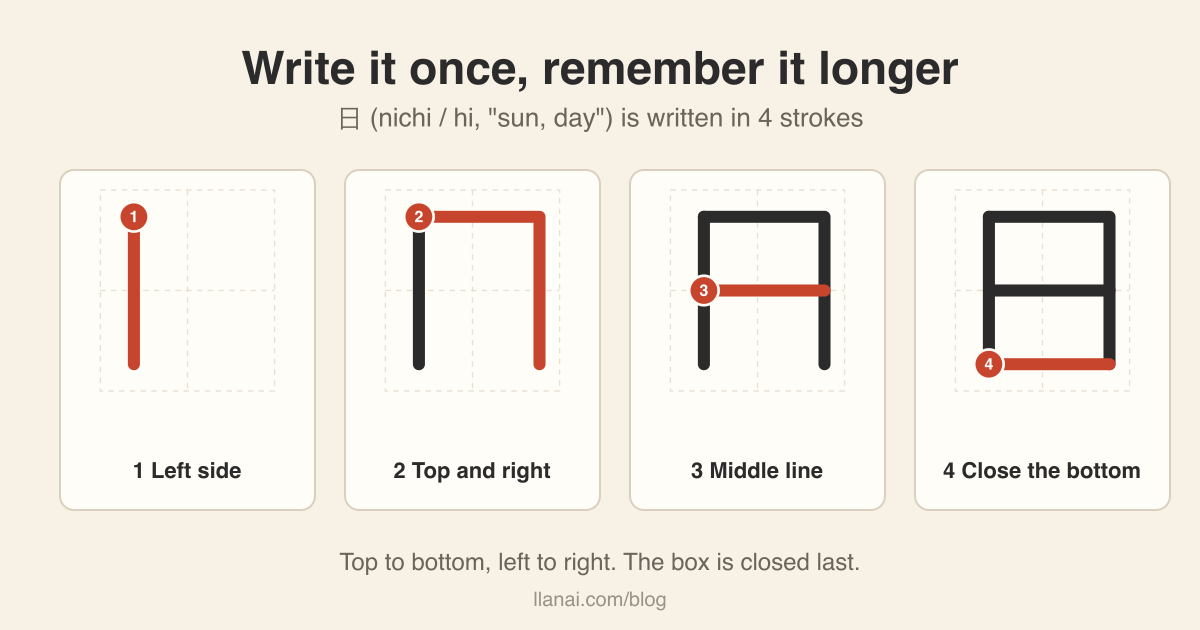
One more worth knowing early: in a box like 日 or 口 (kuchi, "mouth"), the box is closed last. You draw the left side and the top-and-right, write whatever goes inside, and then close the bottom.
A 10-Minute Routine for N5 Beginners
Do this with 3 to 5 kanji per session, not 30.
- Watch it once. Open the character on MichiKanji and watch the stroke animation. For example, here is 日. (We covered the site in our MichiKanji review.)
- Trace it twice. Follow the diagram slowly. Say the stroke count out loud as you go.
- Copy it five times. Look at the model each time. Keep the strokes in order even when you speed up.
- Cover the model and write it from memory. Do this three times. If you stall halfway, uncover it, finish, and try again.
- Say the word, not just the kanji. Write 日本 and say nihon. Write 水 and say mizu ("water"). Writing doesn't teach pronunciation, so pair it with sound on purpose.
- Test yourself tomorrow. Write the same kanji from memory on a blank page before looking at anything. This is the step that does the most.
Don't judge your handwriting. Correct stroke order and proportions matter; beauty doesn't.
Free Practice and a Paper Option
You can do all of the above for free. MichiKanji has free printable N5 kanji practice sheets, and the animated stroke order for each character is on the site.
I also made a paper version. Full disclosure: I wrote this book, so weigh my recommendation accordingly. N5 Kanji Stroke Order & Writing Practice covers all 82 JLPT N5 characters, with one facing spread for each:
- Left page: the stroke order diagram and the words that use the kanji.
- Right page: 132 practice squares.
It is for people who would rather write in a book that lies open on the desk than manage a stack of printouts. If you are happy with the free sheets, keep using them. They teach the same thing.
Where to Go Next
- Pick five kanji from your current N5 list and run the routine above for a week.
- Keep a running list of the pairs you confuse and write each pair side by side.
- Pair writing with an app for the readings. Our post on the best app for studying Japanese compares options.
- Drill the katakana look-alikes too. シ, ソ, ツ and ン have the same problem, and stroke direction is the fix: シソツン stroke order.
Writing by hand won't do the learning for you, and the research doesn't claim it will. What it does is slow you down enough to notice what you are actually looking at. For a beginner, that is usually the missing piece.
